
Cubism and Futurism Look Like Chaos…
For Completely Different Reasons
Stand in front of a Cubist painting and a Futurist painting side by side, and your first instinct might be to lump them together. Both look fractured. Both refuse to give you a clean, single view of anything. Both seem to be actively resisting the idea that a painting should look like a photograph.
But the two movements were solving completely different problems — and once you know what each one was actually trying to do, the "mess" resolves into two very different kinds of logic.
Cubism: One Object, Every Angle At Once
Take Georges Braque's Still Life with Clarinet, Fan, and Bunch of Grapes (1911). At first glance it's a jumble of overlapping shapes in muted, almost monochrome tones. But Braque isn't being random — he's doing something very specific: showing you an object from multiple viewpoints simultaneously, folded into a single image.
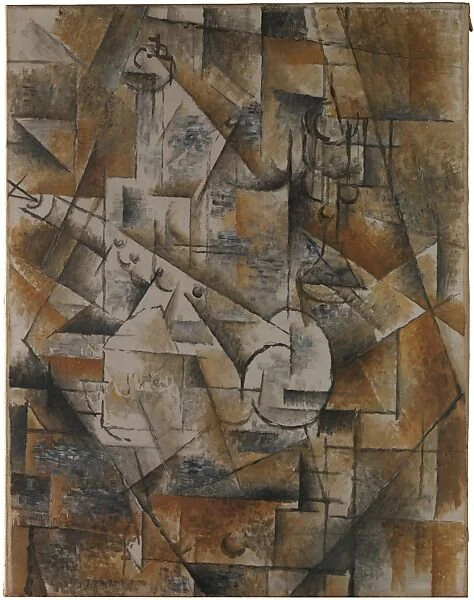
Think about how you actually get to know an object in real life. You don't see it from one frozen angle — you walk around it, pick it up, turn it over. Cubism tried to paint that fuller, multi-angle knowledge of an object rather than the single, arbitrary snapshot a camera (or a traditional painting) would give you. One Futurist painter, writing about this technique in a 1911 letter, described it as painters showing half an object from one angle and immediately placing the other half beside it, dissected almost like an engineer's technical drawing.
This is the painting phase art historians call Analytic Cubism, and Braque's still life shows the hallmarks clearly: color is almost entirely sacrificed in favor of a more disciplined, geometric approach; forms are stripped down to only what's needed to recognize the subject; objects pile on top of each other instead of sitting in tidy foreground/background planes; and light comes from no single consistent source, so shadow and highlight sit next to each other with a kind of calculated inconsistency.
Braque himself said that what drew him most to this whole approach — really the guiding idea behind Cubism — was finding a way to physically materialize the sense of space he perceived, to pull that space closer to the viewer rather than keeping it politely at a distance. Still life was his favorite vehicle for this because a bowl of fruit or a clarinet sitting on a table gave him tight, controllable subject matter to work out these advances and retreats of space — sometimes literally breaking an object's outline so the surrounding space could bleed into it.
Crucially, Cubism never wanted to tip over into full abstraction. The objects stayed recognizable, however fragmented. The point was reinvention of a stable, still object seen from many angles — not motion.
Futurism: An Object Refuses to Sit Still
Now look at Umberto Boccioni's Dynamism of a Soccer Player (1913), painted two years after Boccioni encountered Cubism on a trip to Paris. It's almost impossible to pick out a recognizable human figure in it — which is, in a sense, the entire point.
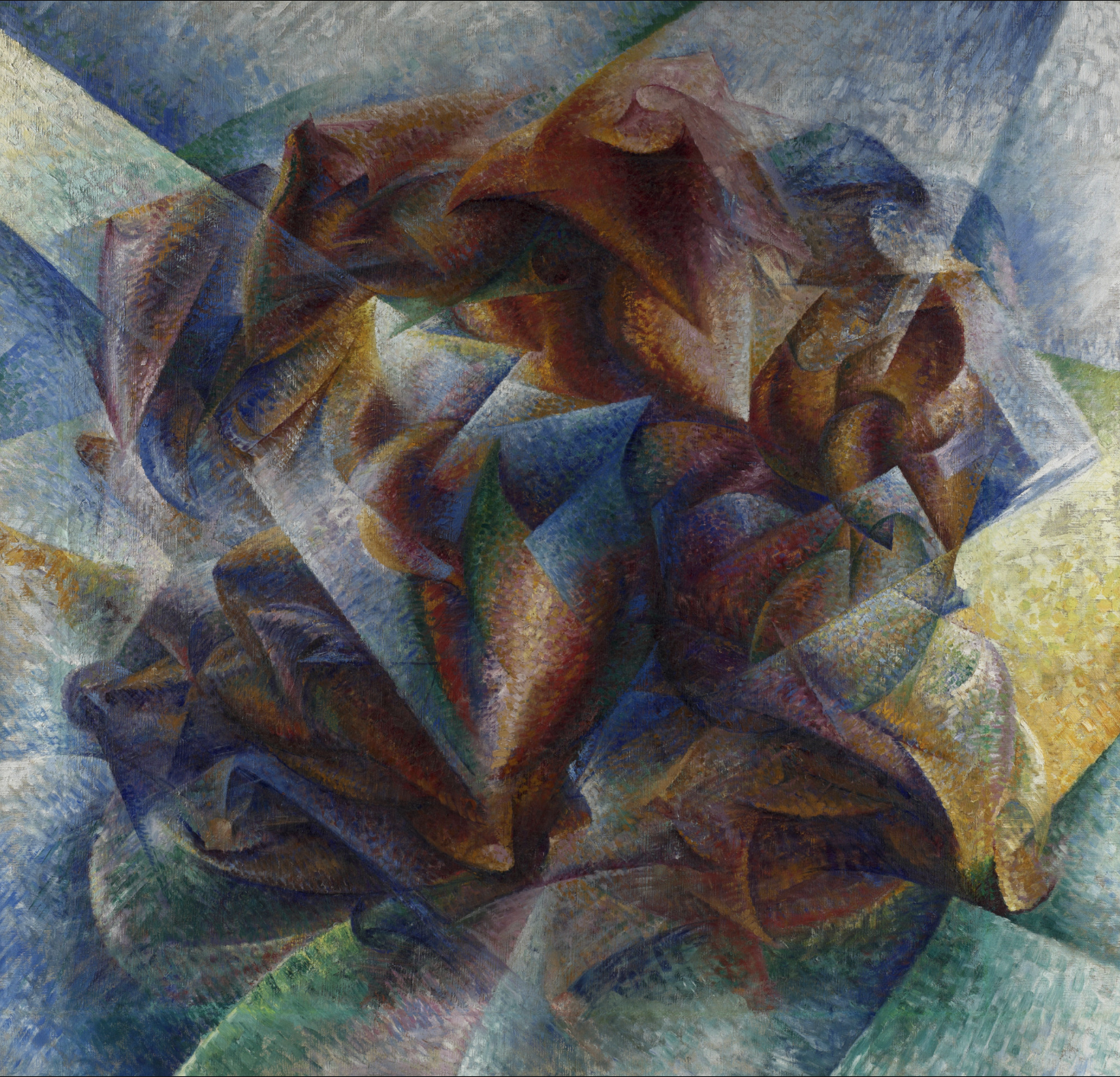
Futurism was born in Italy as a celebration of machines, speed, modernity, and (unsettlingly, in hindsight) violence. Where Cubism wanted to show a static object from multiple angles, Futurism wanted to paint an object that was never static in the first place. Boccioni, one of the movement's leading voices, wrote in a manifesto that everything is constantly moving and transforming, that no figure ever truly sits still in front of us, and that things in motion multiply and blur into each other like vibrations passing through space. He argued that art needed to catch up to the intellectual needs of its own moment rather than clinging to the past.
Technically, this meant something quite different from Braque's approach. Instead of Cubism's shifting viewpoint, Futurism used a divisionist color technique — repeating and overlapping images, shifting hues — to build a sensation of speed and motion directly into the paint. Where Braque drained color down to near-monochrome, Boccioni reached for bold, contrasting, near-clashing colors specifically to heighten the feeling of motion.
Notice, too, what each artist does with the canvas itself. Braque tends to spread his fragmented forms out across the whole picture plane. Boccioni instead uses fragmentation to funnel your attention toward the center of the canvas, where the moving figure supposedly is — even though you can barely make it out.
And that title, Dynamism, is doing a lot of work: the fact that the subject happens to be a soccer player is almost beside the point. It could have been a car, a dancer, a train — Boccioni was chasing motion itself, not sport.
Same Moment, Different Questions
Both movements were reacting to the same modern world — but they were asking it different questions. Cubism asked: if I could see an object from every angle at once, what would that look like? Futurism asked: if I could paint an object across every moment of its motion at once, what would that look like? Cubism was interested in simultaneity of perspective. Futurism was interested in simultaneity across time.
The Futurists themselves knew they owed Cubism a debt. One of their own, in that same 1911 letter, credited the Cubists with striking a real blow against the art academy's stuffy conventions — for refusing to keep painting pretty, brightly-colored landscapes, and for treating color and form as vehicles for sensation rather than as the entire goal of a painting. It's a rare moment of one avant-garde movement openly admitting it was building on another's foundation, even while pushing the idea somewhere its originators never intended to take it.
Sources & further reading: Nikos Stangos, "Concepts of Modern Art"; Ester Coen, "Umberto Boccioni" (The Metropolitan Museum of Art); Germain Bazin, "Historia del Arte"; Susie Hodge, "Breve Historia del Arte"; Mario De Micheli, "Las Vanguardias Artísticas del Siglo XX."
