
The Movement That Tried to End "Art for Art's Sake"
Here's how far that ambition went, and where it fell short.
There's a version of art history where paintings hang quietly in museums, admired by a small circle of collectors and critics, disconnected from anything happening in the street outside. For most of the 19th century, that was more or less the deal — art had become its own separate, self-contained world, answerable only to itself.
Then a group of Italian artists got very loud about wanting to burn that whole arrangement down.
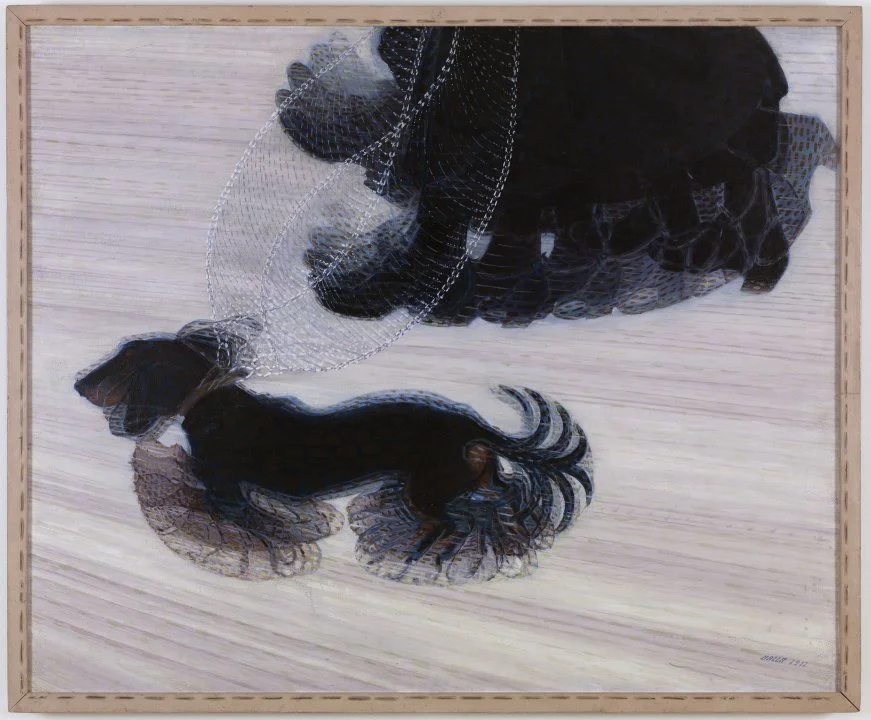
Dynamism of a Dog on a Leash, 1912 - Giacomo Balla
Art That Only Talks to Itself
To understand what the early-20th-century avant-gardes were actually rebelling against, it helps to borrow a framework from the critic Peter Bürger. Bürger argued that by the 19th century, bourgeois art had achieved a kind of complete independence — what he called autonomy — across three fronts: why art got made, how it got produced, and how it got received. Art had drifted into serving only optional, decorative needs rather than anything essential to daily life. It had become something made by one individual, for one individual, in a closed loop that barely touched the wider world.
The avant-gardes, in Bürger's reading, were a direct reaction against exactly that isolation. Their shared project — however differently each movement carried it out — was to drag art back into praxis, back into the actual, lived business of everyday existence. To make art matter again, rather than just decorate a room.

Futurism Got There First — and Said So Loudly
Futurism has a strong claim to being the first movement to explicitly announce itself as a movement — the first to write its own mission statement before really finishing the art that was supposed to embody it. Its founding manifesto argued that only art rooted in its surrounding environment could really be called alive, and its members backed that claim with a flood of manifestos covering nearly every corner of daily existence: architecture, music, design, poetry, literature, cooking, painting, sculpture, photography, film, theater, politics, fashion, even romantic love got its own Futurist manifesto.
That's a strikingly literal attempt to make good on the idea that art shouldn't sit apart from life — it should invade every room of it. One scholar of the period has described this as the avant-gardes beginning to apply their ideals across every sphere of society, with real freedom in how they used language and form, effectively declaring that art-for-art's-sake was finished and pushing into genuinely new territory.
Futurism also helped revive something the 19th-century model had lost: collective production and reception. Its members worked publicly toward shared goals laid out in these manifestos, and it staged rowdy public events — evenings of performance, noise, provocation — that folded music, cinema, and theater together and often turned the audience itself into something closer to a single, agitated crowd. Those evenings would go on to directly inspire movements like Dada.
Where Futurism Fell Short
Here's the more complicated part of the story: for all its ambition, Futurism didn't fully pull off what it set out to do.
Even though the movement was loudly revolutionary in its rhetoric, it never actually abandoned the technical toolkit of traditional painting and sculpture the way later avant-garde gestures would. The ready-made, for instance — an ordinary object simply chosen rather than crafted — represents a much more complete break from traditional artmaking than anything Futurism produced. Futurism talked about dissolving the boundary between art and life, but it kept making paintings, in the end.
There's also a darker note to the story. The movement's members famously glorified war, at times describing conflict in unsettling terms as a kind of cleansing force for the modern world. When the First World War actually arrived, it took several of the movement's most important figures and badly undercut the optimistic, techno-utopian worldview Futurism had been selling. The movement that had celebrated speed, machines, and violence as liberating forces ran headlong into the actual consequences of mechanized violence — and didn't fully survive the collision.
What Futurism Left Behind
Even so, Futurism's influence outlived the movement itself. It set a pattern nearly every subsequent avant-garde would follow: publish your manifesto, declare your principles, root your work explicitly in its social moment, and treat art-making as something closer to a collective, public act than a private, individual one.
There's something almost poignant in how self-aware Futurism was about its own mortality — its founding manifesto openly predicted its own eventual obsolescence. In a strange way, that built-in expiration date became part of its legacy too: the avant-gardes that followed inherited the understanding that a movement's life span was tied to how well it kept serving the society around it — not to how long it could keep repeating itself.
Sources & further reading: Peter Bürger, "Teoría de la Vanguardia"; Nikos Stangos, "Concepts of Modern Art"; Mario De Micheli, "Las Vanguardias Artísticas del Siglo XX"; Manuel Fontán del Junco, quoted in "Cuando la vanguardia llevó el arte a la vida," El País (2012).
